
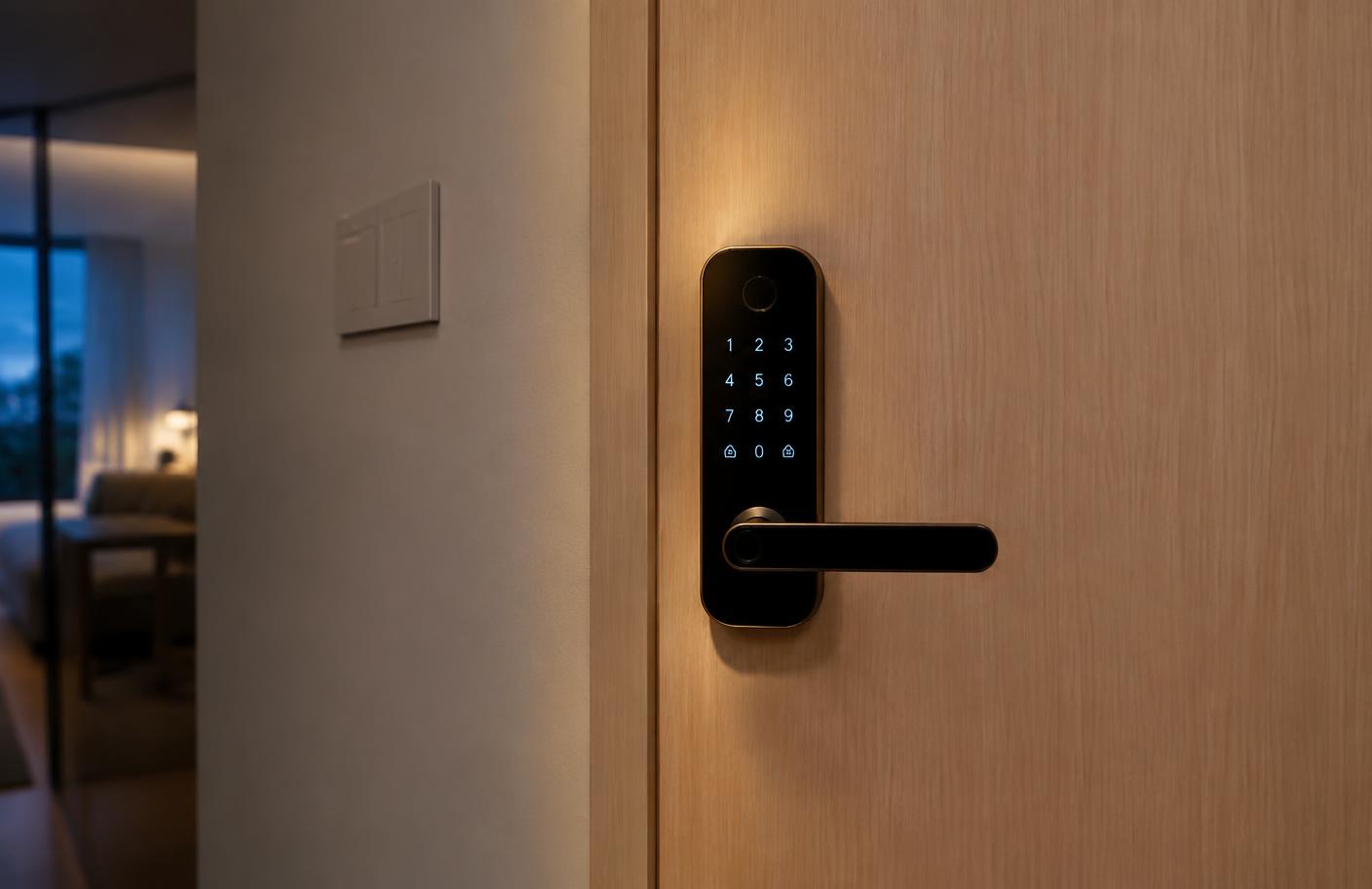
Ask a locksmith whether smart locks are worth it and you will usually get a pause. Not because the technology is bad, but because the answer genuinely depends on the household, the door and the expectations involved.
Fitted to the right door for the right reasons, a keypad or app-controlled lock is one of the most useful upgrades available. Fitted to the wrong door or chosen from a product page without measuring anything, it becomes the thing you call a locksmith about six months later.
The problems smart locks genuinely solve
The first is the hidden spare key. Almost every household has one somewhere — under a pot, in the meter box, with a neighbour. A code removes that weakness entirely, and codes can be different for different people.
The second is scheduled access. Cleaners, trades, dog walkers and family visiting while you are away can each have a code that works only when it should, and that you can delete afterwards without changing anything physical.
The third is the lockout itself. If keys are routinely forgotten, misplaced or taken to work in the wrong bag, a keypad simply ends the problem. For households with teenagers this alone often justifies the purchase.
Short-stay and holiday rentals are the clearest case of all. Codes that expire at checkout remove key handovers, lockbox fiddling and the risk of a guest walking off with a key — particularly useful in beachside suburbs like Aspendale and Parkdale where holiday letting is common.
The problems they can create
Batteries are the obvious one, though less of an issue than people fear. Quality units warn for weeks, and every model worth installing has a mechanical key override or an external power contact. The risk is not the battery dying; it is ignoring four weeks of warnings.
Door fit is the real issue. Smart locks are heavier and deeper than conventional hardware, and they demand accurate alignment. A door that already drags in winter, or a strike that needs a shoulder to close, will cause a motorised bolt to jam and drain batteries fast.
There is also a household factor. Every person who uses the door needs to understand the system, including anyone who is not comfortable with phone apps. A lock nobody can operate under stress is not an upgrade.
Keypad, fingerprint or app?
Keypad entry is the most reliable and the easiest to share. Codes work whether or not the internet does, and a four to six digit code is something anybody can use. For most homes this is the right primary method.
Fingerprint readers are fast and pleasant to use, but performance varies with wet, cold or worn fingertips — worth thinking about for a beachside door where hands are frequently damp and sandy.
App and remote access is genuinely useful for letting someone in while you are elsewhere, and for seeing an access log. Just remember that remote features depend on your network, while codes and fingerprints work locally on the lock itself.
- Keypad — most reliable, easiest to share, works offline
- Fingerprint — fastest daily use, less consistent with wet hands
- App — best for remote access and logs, depends on your network
- Mechanical override — keep it, and key it to your existing system if possible
Security: better or worse than a deadbolt?
A quality smart lock on a properly aligned door with a reinforced strike plate is at least as secure as a conventional deadbolt, and it removes the spare-key vulnerability that undermines a lot of otherwise good hardware.
The weaknesses are different rather than greater. Codes can be shoulder-surfed, so change them periodically and clean the keypad — worn digits are an obvious clue. Cheap units with flimsy internal mechanisms are a genuine risk, and the market is full of them.
As with any lock, the door and frame matter more than most people expect. No lock of any kind resists a forced jamb, so strike reinforcement should be part of any installation.
Choosing one without regretting it
Measure before you buy. Door thickness, backset, whether the frame is timber or aluminium, and the existing cutout all determine which models will physically fit. This is the single most common reason a new smart lock cannot be installed on the day it arrives.
Check the override. There should be a mechanical key cylinder, and ideally one that can be keyed to match your other doors so a backup key still opens everything.
Buy on build quality rather than feature lists. A solid unit with a keypad and a good motor will outlast a cheaper model advertising ten unlocking methods, and the parts will still be available in five years.
So — worth it?
For households that share access frequently, forget keys regularly or run a short-stay property, yes, clearly. The daily benefit is real and the failure modes are manageable.
For a single household with reliable key habits and a door that closes perfectly, a good deadbolt and a spare key with a neighbour does the same job for a fraction of the cost. There is no shame in the low-tech answer.
If you are unsure, have the door assessed first. Knowing what will physically fit narrows the decision far more than any amount of reading, and it stops you buying hardware your door cannot take.
Want this handled rather than researched?
Call and describe the situation. We'll tell you what's involved before anyone is dispatched.
Call 03 7057 3054